The CMOS sensor research activities of the TAPEC group are now focused in Selective Change Driven Vision which is an increasing interesting research area. The rest of this page is devoted to the CMOS log-polar vision sensors designed at the end of the last century and early XXI century.
Vision chips, or sometimes called smart vision sensors, which are also famous as "silicon retinas", are those chips that have integrated the image acquisition and parallel processing at the pixel level, in one chip.
The CMOS technology has demonstrated the possibility of making cheap, easily customizable visual sensors for solid state cameras. CMOS also has the possibility to include signal processing on the chip itself. Only the image quality is worst than the CCD technology, but only "humans" are interested in nice pictures while systems or robots are more interested in pictures that are good enough to complete a specific task.
There is a special way for image capturing very similar to the human eye with some mathematical properties. This representation is called the log-polar or log spiral mapping. Though the advantages of this special representation have been demonstrated time ago, only now, with the improving and the availability of the microelectronics processing, it has been possible to implement sensors using this special representation, also called retinal or foveated, since it is very similar to the human eye.
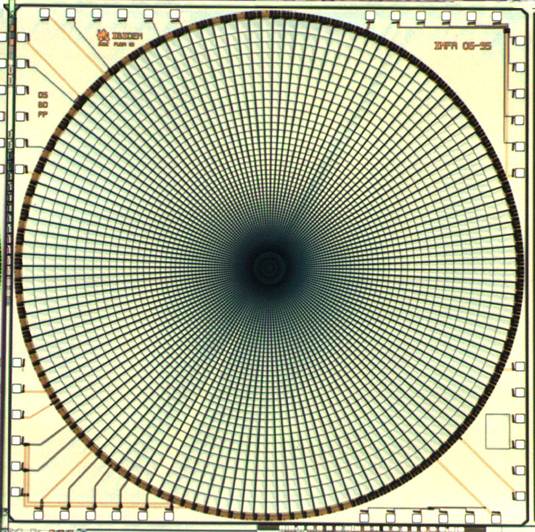
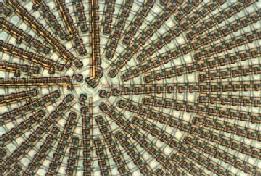
The following pictures shows the layout of the special retinal sensor designed by Fernando Pardo (et alt.) at IMEC. (This pictures are copyright of IMEC and can be fetch along with technical data sheets of the sensor at http://www.imec.be/) Left: sensor layout. Right: detail of the fovea (sensor center):
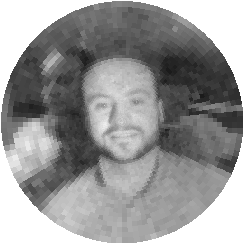
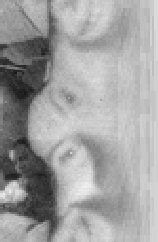
The following images are pictures taken with the retinal camera (left: retinal or image plane, right: cortical or computational plane):
The following sensors are well documented retinas designed to date:
A compilation of these an other smart sensors has been made by Alireza Moini, at the University of Adelaide. See Vision Chips PDF or Vision Chips Web page.